Requests buffered data to be transmitted on an advanced program-to-program communications (APPC) mapped conversation.
An APPC conversation allows a program to send data to, and receive data from, a program that is running in a remote system.
Programming that uses APPC conversations is called Distributed Transaction Programming (DTP).
For guidance information about DTP, refer to the TXSeries for Multiplatforms Intercommunication Guide.
Sintaxe:
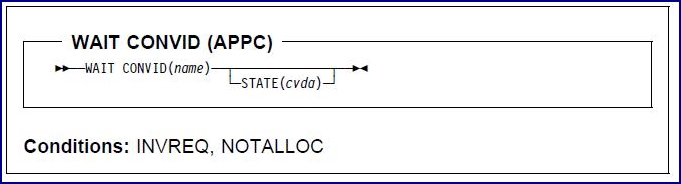
Descrição:
WAIT CONVID allows an application program to ensure that any accumulated application data from a SEND command, or the
results of a CONNECT PROCESS command, are transmitted to the partner transaction.
Opções:
CONVID(name)
- Identifies the conversation to which the command relates.
- The four-byte name identifies either the token that was returned by a previously executed ALLOCATE command in the EIBRSRCE
field of the EXEC Interface Block (EIB), or the token that represents the principal facility (that was returned
by a previously executed ASSIGN command).
STATE(cvda)
- Gets the state of the current conversation.
Condições:
NOTALLOC
- Occurs if the specified CONVID value does not relate to a conversation that is owned by the application.
- Ação pré-definida: Terminates the task abnormally.
INVREQ
- Occurs for the following conditions, depending on the options that are specified on the WAIT CONVID command:
- When an attempt is made to use a distributed transaction processing (DTP) command on a valid non-DTP CONVID.
- When WAIT CONVID is not valid for the current state of the APPC conversation.
- A remotely linked-to program attempted to execute a WAIT CONVID command that refers to the principal facility.
- Ação pré-definida: Terminates the task abnormally.
Informações relacionadas:
© Copyright IBM Corp.